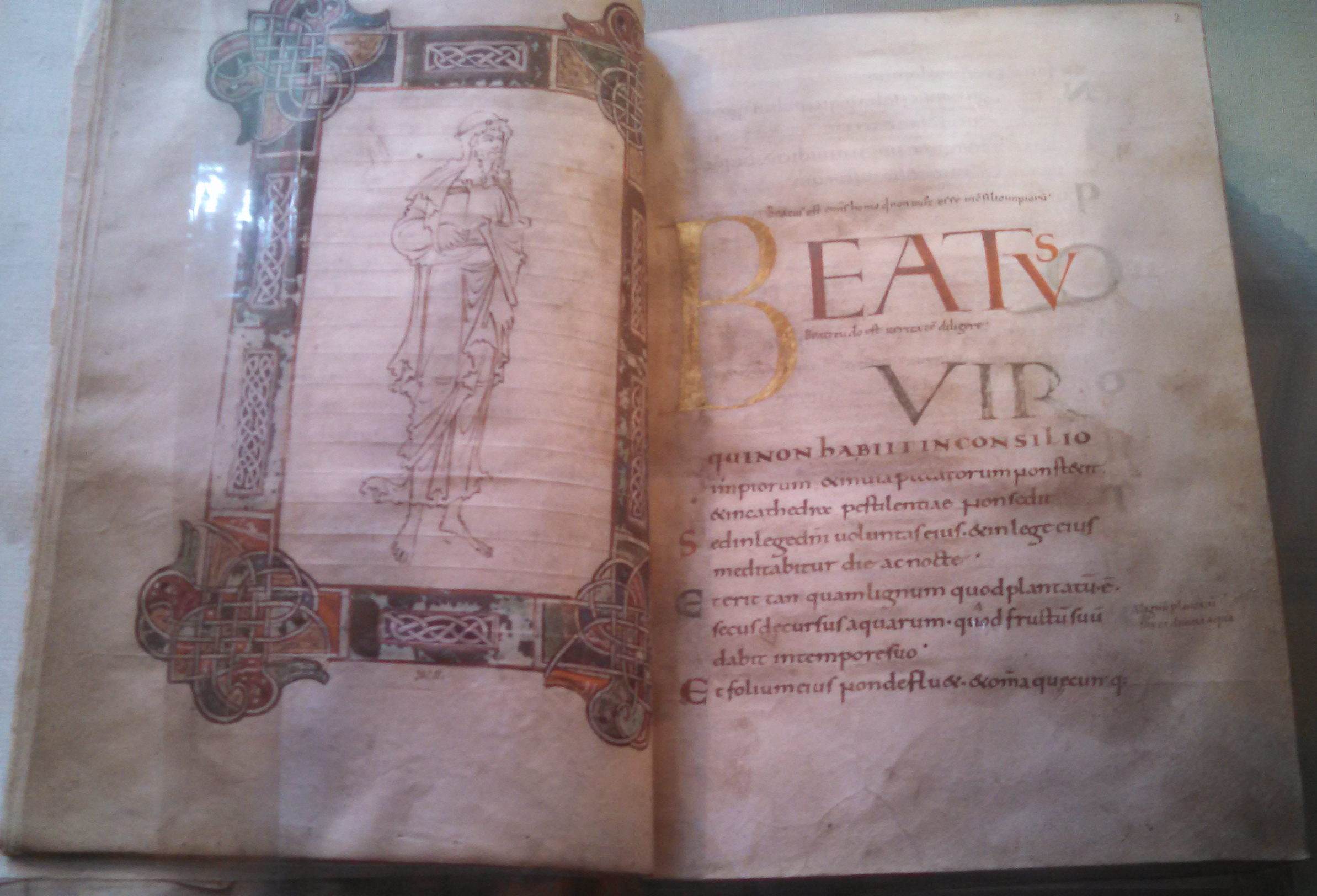

Ps 2:9—”You shall break them with a rod of iron”
The term usually translated “break” in English Bibles has an interesting rendering in the Septuagint. In the Septuagint, we find, “You will shepherd them with a rod of iron.” The explanation is simple enough. In unpointed script the Hebrew could be understood as “break” or “shepherd.” That is to say, תרעם could be derived from רעע (“break,” or “shatter”; cf. Job 34:24), or רעה (“shepherd,” “lead,” “rule”; cf. Mic 7:14, which has a very similar construction).
The context, at first blush, appears to favor the sense of “break.” Because repetition is a well-known literary device in Hebrew poetry, and because the second part of verse 9 reads, “You will dash them in pieces,” it would make sense for the first line of the verse to have a similar meaning, namely, “break” or “shatter.” It may very well be that this was the author’s intention. However, “shepherd” makes good sense too, particularly when one considers that Micah 7:14 has a similar phrase (i.e., רעה [עמך] בשבטך: “Shepherd [your people] with your rod/staff”). Additionally, in the Book of Psalms, the verb רעע, “break/shatter,” is never used elsewhere, while רעה, “shepherd,” is used 7 times. Outside the Psalter, the Hebrew root רעע with the sense “shatter,” or “break” is fairly rare, occurring only 10 times compared to 166 occurrences of רעה. This would likely lead most interpreters of an unpointed Hebrew text to understand the verbal form to be derived from רעה, unless the context suggested otherwise.
Around the end of the 2nd c. BCE, when the Psalms were translated into Greek, the translator understood the Hebrew to mean “shepherd.” This seems natural enough based on the information provided above. But I should say, I do not think the translator’s choice was something he contrived on his own—it most likely reflects a received tradition of what the Hebrew text meant. Other Jewish communities of the same time may have understood the Hebrew differently (i.e., “break”); however, the Old Greek translation is good evidence that the Hebrew was widely interpreted to mean “shepherd.” The Greek translation, ποιμανεῖς (i.e., “you will rule/shepherd”), was brought into the text of Rev 2:27 with slight modification (ποιμανεῖ: “he will rule/shepherd”), which shows that the interpretation was still current in the early common era. However, as the pointing of the Hebrew text (i.e., תְּרֹעֵם) in edited Bibles indicates, the understanding changed at some point in the common era. Symmachus (2nd c.), one of the revisers of the Greek translation of the Old Testament/Hebrew Bible, reflects the changed understanding of the Hebrew. He translates the Hebrew with συντρίψεις (“you will shatter”; this is Fredrick Field’s backtranslation of the Syriac, tshhwq, of the Syro-Hexapla).
I’m not sure why the interpretation of the Hebrew changed (or, why the “break” interpretation gained prevalence), but it did. Perhaps because תרעם was seen to be parallel in meaning to תְּנַפְּצֵם (“you will dash them to pieces”). Interpreting the Hebrew with the Old Greek translator seems to be more consistent with the warning of verses 10-12 of the psalm. In the following verses the nations are told to act wisely. If the messiah is just going to smash them with an iron rod, it doesn’t make as much sense to warn them against lighting his fuse, so to speak. But if he wields an iron rod, which he could use to smash the nations that rebel against his authority (like a shepherd would wield his staff to fight off predatory animals), then a warning makes better sense.
What do you think?
 Brian P. Baucom