

“Kiss the Son, lest he be angry, and ye perish from the way, when his wrath is kindled but a little. Blessed are all they that put their trust in him” (Ps 2:12, KJV).
Introduction
Though not the first English Bible version to translate the Hebrew text in this way, the King James Version has been very influential in the transmission of the Bible in English. The original KJV translation committee (way back in the early 1600s) compared existing English translations to one another and to the available Hebrew and Greek manuscripts in order to produce the most accurate and eloquent translation possible. Though the KJV followed prior translations for this verse from Ps 2, it no doubt had heavy influence in perpetuating the reading in subsequent English Bible versions. The most popular English versions translate the verse with “Kiss the son,” or something similar (e.g., “Do homage to the Son” [NASB], “Submit to God’s royal son” [NLT]). The Catholic Douay-Rheims Bible, which translates the (Latin) Vulgate, reads as follows: “Embrace discipline, lest at any time the Lord be angry, and you perish from the just way. When his wrath shall be kindled in a short time, blessed are all they that trust in him” (italics added).(1) The KJV and others are based on the Hebrew, while the Vulgate in the Psalms is based on the Greek Septuagint. We’re interested in whether or not “kiss the son” is a good translation of the Hebrew, especially since the Septuagint translator, the earliest known translator, does not render the Hebrew with this understanding. If you’re not too interested in the details (and it does get a bit technical), please skip down to the conclusions.
Details
The Hebrew text we know in modern editions for the English phrase, “Kiss the son,” is נַשְּׁקוּ־בַר (my apologies, the pointing isn’t coming through), or nashequ bar (נשקו בר in unpointed script). The Hebrew נשק (nashaq) does indeed mean “kiss.” The Greek translator of the Psalms did know this, which is reflected in his translation of Ps 85:11 (Ps 85:10 in Eng, Ps 84:11 in Grk). Here the translator renders nashaq with κατεφίλησαν, katephilesan (i.e., “kiss”). So why would the translator render the Hebrew with δράξασθε, draxasthe, “grab,” or “seize,” in Ps 2:12? Δράσσομαι, drassomai, “seize,” is an uncommon word in the Septuagint corpus, which only translates the Hebrew verb קמץ, qamatz, or “take a handful,” elsewhere (3x; Lev 2:2, 5:12, Num 5:26). The Hebrew verbs (קמץ and נשק) hardly seem like they could be confused for one another; however, if the translator had a moment of dislexia, he may have seen קמץ instead of נשק (particularly when paleo-Hebrew scripts are taken into consideration).(2)
Another possibility is that the Greek translator saw חשק, chashaq (i.e., “cling to”), which has a closer visual similarity to נשק than that mentioned above (i.e., קמץ). The meaning of חשק is likewise close to δράσσομαι, “grab,” of the Septuagint. However, חשק occurs in Ps 91:14 where the Greek translator renders the Hebrew verb with ἤλπισεν, elpisen, “he hoped.” One can see how the Greek translator would interpret חשק this way in the context of Ps 91 (e.g., “Because he holds fast to me in love, I will deliver him; I will protect him, because he knows my name” [ESV]; in the Septuagint it is, “Because in me he hoped, I will also rescue him; I will protect him, because he knew my name” [NETS, emphasis added]). The conjecture that the Greek translator read חשק at Ps 2:12 would require there to be some inconsistency on the part of the Greek translator (because of the translation at Ps 91:14); however, the rarity of the Hebrew term in the Psalter (1x) undermines any certainty of the translator’s technique with this particular Hebrew word.(3)
One last possibility concerning the Greek reading of the Hebrew verb occurs to me, and, in my estimation, seems most likely. I think the Greek translator mistook the Hebrew verb before him (נַשְּׁקוּ, apologies again for the pointing) for נַקְּשׁוּ, naqqeshu, “seize.” The resultant translation, δράξασθε, draxasthe, “grab,” or “seize,” is equivalent in meaning, which favors the interpretation. The verb נקש occurs only 5 times in the Hebrew Bible. Of these 5 occurrences, 3 are found in the Psalter. The other occurrences of נקש in the Psalms are translated variously into Greek. In Ps 9:17, we find συλλαμβάνω, sullambano, “seize,” or “catch.” In Ps 38:13 (Grk: 37:13), we find ἐκβιάζω, ekbiazo, “press upon,” “exploit,” or “take to violence” (NETS). In Ps 109:11 (Grk: 108:11) we find, ἐξερευνάω, exereunao, “search out.” There is no consistent translation equivalent.(4) That could indicate uncertainty of the Hebrew verb’s meaning on the part of the Greek translator; however, it could also reflect his interpretative touch in the distinct contexts of the different psalms. If the translator saw נקש in Ps 2:12, then it would not be surprising for him to render this verse with yet another different verb since he has no consistency with this verb elsewhere. That said though, δράξασθε, draxasthe, “grab,” is close in meaning to his choice at Ps 9:17 (συλλαμβάνω, sullambano, “seize,” or “catch”).
Perhaps the greater difficulty with the Greek translation is the rendering of בר, bar, “son,” with παιδείας, paideias, “instruction.” Why would the translator understand בר, “son,” to mean “instruction”? He wasn’t alone in reading something other than בַּר meaning “son”—most early translators and revisers did not understand the Hebrew to mean “son.”(5) The only early translation that does interpret בר as “son” is the Syriac, which is a dialect of Aramaic. The Syriac translator may have actually taken his interpretational cues from v. 7 where he had translated the Hebrew word for “son,” בן, with the Syriac word bar (ܒܪܐ), “son.” The Syriac translation of “son” at Ps 2:7 (i.e., bar, or ܒܪܐ) may have led to an unconscious decision to read בר, bar, as the Aramaic noun meaning “son” at Ps 2:12.
Is the translation of בר as “son” viable? The Syriac speaking community of Bible readers understood the text in this way, which may reflect a wider interpretational tradition. We’ve briefly mentioned one possibility for how the Syriac translator may have come to his interpretation. How may modern English versions that translate the Hebrew בר as “son” justify their interpretation? First off, it should be noted that the Aramaic word בר does appear in one Hebrew text (i.e., excluding Aramaic sections) of the Hebrew Bible where it means “son.” In Prov 31:2, בר must very clearly mean “son.” The Septuagint translator himself translated בר here with τέκνον, “child.” However, at Ps 2:12, only one early interpreter understood the text to mean “kiss the son,” which raises serious questions as to the interpretation’s validity.
The translation “kiss the son” is obviously acceptable because of all the English translations that go with it. The translators and editors of the English Bible versions come to an informed decision regarding how they interpret and translate the Hebrew Bible. “Kiss the son” is certainly defensible; however, there are weaknesses. First of all, the Hebrew word for “son,” בן, is used in v. 7. This seems to militate against the introduction of the Aramaic word in v. 12. However, there is the argument that the nations, who spoke the more widespread Aramaic, are being addressed in v. 12, whereas v. 7 is a quotation of YHWH to his anointed king, who, as an Israelite, spoke Hebrew. It’s a reasonable point. However, the more difficult problem with v. 12 and the introduction of בר with the meaning “son” is that there is no definite article attached. The “son” in v. 7 (i.e., בן, ben) is made definite by the pronoun “my.” The son is YHWH’s son. In v. 12, the speech is now turned to the nations. The problem with the indefiniteness of בר is that we must assume the nations knew who bar, “son,” was. Was bar a common enough noun for the reader/hearer from another nation to understand who was being referenced? Contextually we might presume that the reader/hearer would understand bar is the “son” who was mentioned above in v. 7. But why would the psalmist change to Aramaic? We must also assume that the nations referenced in the Psalter (i.e., those surrounding Israel and speaking the Aramaic language) are reading or listening to Israel’s Psalter. This seems unlikely. Concerning the commonness of the noun בר, meaning “son,” it does not occur elsewhere in the Hebrew sections of the Hebrew Bible in such a way that it could be understood to be functionally definite (cf. Prov 31:2 where בר is definite, which is the only other occurrence of the noun with the meaning “son”).
There is the possibility that בר is actually a substantive adjective deriving from the Hebrew verb ברר, barar, meaning “choice one.”(6) Allowing for this, the same problem exists. The substantive is indefinite. There are occasional instances in the Psalter where substantive adjectives are indefinite with a definite quality. Ps 37:37 may be the most important verse for comparison to Ps 2:12. In Ps 37:37 we find, שְׁמָר־תָּם וּרְאֵה יָשָׁר, “Watch the perfect man, and look at the upright man, [because the last days for such a man are peace].” The verse could be understood with indefinite substantives (i.e., “Watch a perfect man, and look at an upright man, [because the last days for such a man are peace].”). For the sake of argument, we’ll assume the substantives are definite. The substantives are common enough in the Psalms that they basically form a recognized category of people: the perfect and the upright. They don’t need to be grammatically definite because they are a recognized, definite group of people. This relates to Ps 2:12, because if we are to assume בר is an indefinite adjective acting as a definite substantive noun (“the choice one”), then we should expect the adjective to be common enough to be understood as a definite noun. However, this is apparently not the case. The only other possible instance of בר meaning “choice one” in the Hebrew Bible is definite (Prov 31:2, cf. note 6; Kompaore argues for this meaning), in which context it is usually understood to mean “son.”(7) The rarity of the word בר suggests that the indefinite noun (“a son”), and indefinite substantive adjective (“a choice one”), are unlikely to have been understood as functionally definite.
So what does bar mean? Or was there a different Hebrew text, as the Greek and Aramaic (Targum) translations have led some scholars to believe?(8) The Hebrew text of modern editions (i.e., נשקו בר) appears to have been what Aquila, Symmachus, and Jerome (iuxta Hebraicum) had before them as they did their revising and translating. Aquila translates, “καταφιλήσατε ἐκλεκτῶς,” “kiss purely,” which is consistent with his translation equivalents for נשק and בַּר (“pure”) elsewhere (cf. 1 Kgs 19:18 and Hos 13:2 for נשק, Ps 19:9 [18:9 Grk] for בַּר). Symmachus translates, “προσκυνήσατε καθαρῶς,” “worship purely/cleanly,” which is likewise consistent with his translation equivalents for נשק and בַּר (“pure”) elsewhere (cf. Hos 13:2 and Job 31:27 for נשק; cf. Ps 19:9 [18:9 Grk] and 73:1 [72:1 Grk] for בַּר). Jerome translates, “adorate pure,” which is consistent with his translation equivalents for נשק elsewhere, but not בַּר (“pure”) (cf. 1 Kgs 19:18, Hos 13:2 for נשק). In fact, this is the only place where Jerome translates בַּר with pure. Of the six total occurrences of the Hebrew term בַּר (“pure”) elsewhere in the Hebrew Bible (i.e., that the Naqdanim have pointed as such), Jerome translates three times with mundus (“clean”; Pss 23:4, 72:1, Job 11:4), twice with eligo (“chosen”; Song 6:8, 9), and once with lucidum (“bright”; Ps 18:9). To render the adverbial idea in Ps 2:12 (e.g., “purely”), Jerome had to use pure because mundus is not used adverbally.
So the revisers and Jerome had the same Hebrew text, and they understood it similarly to one another: “Kiss purely” (Aquila); “Worship purely” (Symmachus); “Worship purely” (Jerome). They understood בר to be an adverb with the idea that the nations should show devotion to the Lord without any admixture of malice or rebellion. The nations had conspired against the Lord and his anointed (Ps 2:2), but now they are commanded to “serve the Lord with fear and rejoice with trembling,” and to “worship purely, lest he grow angry.” But is this an acceptable way to understand בר? There is no use of בר as an adverb elsewhere in the Hebrew Bible. Though this does present a challenge to interpreting the Hebrew text in this way, the adverbial option seems like the best option for two reasons. (1) The revisers and Jerome all understood the Hebrew text this way (Jerome may have been influenced by the revisers), which suggests it was a widespread interpretative tradition. (2) The grammatical difficulties discussed above concerning the indefiniteness of the noun and substantive adjective seem more difficult than understanding בר as a unique adverb—that is, occurring only here in the Hebrew Bible. There are a good number of Hebrew words that function as both adjective and adverb and have the same form (e.g., מָלֵא: adv. in Nah 1:10, adj. in Gen 23:9; מַר: adv. in Isa 33:7, adj. in Esth 4:1; תַּמִים: adv. in Ps 15:2, adj. in 18:25, etc.). It would come as no surprise if בַּר served as both adjective and adverb in the Hebrew Bible.
But what about the Septuagint translator? He seems to have seen a different word. The Greek translator never elsewhere translates בר with παιδεία, “instruction” (for any of the variety of possible Hebrew meanings). He does know of the possible meaning “pure,” or “clean,” as is evident in his translation of בר at Pss 17:21, 25 (καθαριότητα, “cleanness”; Hebr. Ps 18:21, 25) and 23:4 (καθαρὸς, “clean”; Hebr. Ps 24:4). It is possible the Greek translator interpreted what would have been an awkward phrase (i.e., “Kiss cleanness”) in its context to mean “seize instruction,” because of the idea of instruction already present in v. 10.(9) As Pietersma notes, it is not out of character for the Septuagint translator to render the Hebrew interpretatively (see note 9). However, the rendering seems like a stretch. A different possibility is that the Hebrew text was very close to the text we now know in modern Hebrew Bible editions. If this were so, the Hebrew text may have had נקשו דע (“seize knowledge”). Although this does not look very similar to נשקו בר (“kiss purely”) in the square script we use in modern Hebrew Bibles, in some of the paleo-Hebrew scripts, which may be what the Septuagint translator read, the readings are very close.(10) As mentioned above, the verb δράσσομαι, “grab,” is close to the meaning of συλλαμβάνω, “seize,” which the Greek translator used to translate נקש in Ps 9:17. The Hebrew noun דע, “knowledge,” does not occur elsewhere in the Psalter; however, the translator did encounter the noun דֵּעָה (“knowledge”), which he rendered with γνῶσις (“knowledge”). In this light, we might expect the translator to have used the same noun (i.e., γνῶσις, “knowledge”) here in Ps 2:12. However, his translational choice in Ps 2:12 may have been conditioned by the near context of v. 10 where the judges of the earth are told to “be instructed” (i.e., παιδεύθητε), which led to his choice of παιδείας (“instruction”). The reading makes sense in the context, and although it is possible it reflects a different Hebrew text, it could also represent a misreading of the Hebrew text we know in modern editions of the Hebrew Bible (see note 10). The Aramaic Targum is in the same interpretational tradition as the Septuagint.
Conclusions
So who’s right? The more modern translations (and the Syriac), which read, “Kiss the son”; the Septuagint and Targum, “Seize instruction”; or the revisers and Jerome, “Worship purely”? Personally, I tend to side with Jerome and the revisers, because they make good sense of the Hebrew grammar and the contextual flow of the psalm. On the other hand, the Septuagint and Targum share an early tradition of interpretation, which could reflect a slightly different Hebrew original, or possibly a mistaken reading of the Hebrew we know in modern editions. Who knows, maybe the Hebrew text here did change slightly between the production of the Septuagint translation and the revisers. This wouldn’t be too surprising because of an understandable transmission error, or scribal misreading. Regardless though, the meaning doesn’t change too much amongst the various translations. The same general idea comes through: obey God. If we take all the interpretations together, we have a rich meaning: Submit to and worship God’s choice son purely—through him you can gain instruction and have life (Ps 2:12).
NOTES
- But, as I said, it has the Latin Vulgate as a base, which is not based on the Hebrew in the Psalter; rather, it is a Latin translation of the hexaplaric Psalter, which follows the Septuagint (Greek) and reflects adaptations according to Origen’s hexaplaric recension of the Psalms.
- This seems unlikely though. See below for possible visual representation of what the Greek translator saw.
 The readings have a closer similarity than the square script (on the left), but this would still require a backwards reading of the text, which is unlikely.
 - The Greek translation of חשק in other biblical books is mostly inconsistent. Of 10 occurrences with a Greek translation (there is once occurrence where there is no corresponding Greek verse), three times the translator chose προαιρέω, “choose,” (Gen 34:8, Deut 7:7, 10:15), and 1x a related form was chosen, αἰρέω, “choose,” (Isa 38:17).
- See also Deut 12:30 (ἐκζητέω) and 1 Sam 28:9 (παγιδεύεις).
- The Septuagint translates, δράξασθε παιδείας, “Seize upon instruction” (NETS). Cf. Vulgate: “adprehendite disciplinam,” “Embrace discipline.” Aquila translates, καταφιλήσατε ἐκλεκτῶς, “Kiss purely/choicely.” Symmachus translates, προσκυνήσατε καθαρῶς: “worship cleanly/purely.” Jerome’s iuxta Hebraicum has “adorate pure,” “Worship purely.”
- Anne Garber Kompaore, “Understanding בר (BAR) in Psalm 2:12,” 6-7 [Cited 12 July 2018]. Online: https://www.academia.edu/12395732/Understanding_בַר_BAR_in_Psalm_2_12.
- The feminine substantive adjective may occur in Song 6:9, but it could be understood in an indefinite way there.
- E.g., C. A. Briggs & E. G. Briggs, International Critical Commentary (1906), 23.
- Cf. Albert Pietersma’s, “Psalm 2,” (1999), 18-19 [Cited 12 July 2018]. Online: http://homes.chass.utoronto.ca/~pietersm/Psalm%202.pdf
- For example, the script may have been close to the text in the image below.
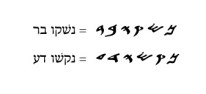 The reading involves a transposition of ק and ש, which did occur from time to time.
 Brian P. Baucom